
The application of five-axis CNC machining in the field of robotics
Core Value
As humanoid robots and collaborative robots move towards industrial-scale production, the demand for high-precision components has soared. CNC five-axis machining, due to its advantages such as completing complex curved surface processing with one setup and achieving micron-level precision control, has become a key technology for manufacturing core components of robots.

Main Application Scenarios
1.Robot joint components
The components such as the joint shaft and the reducer housing need to be strictly controlled for concentricity and mating accuracy (±0.005 to 0.01mm). The five-axis machining can complete multi-feature processing in one setup, eliminating the error of repeated setups and ensuring the stability of the transmission.
2.Robot structural components (bones/frames)
The parts of humanoid robots, such as the elbow supports and leg skeletons, need to be lightweight and of high strength. Aluminum alloys and titanium alloys are commonly used. Five-axis machine tools can efficiently process complex curved surfaces while ensuring the rigidity of thin-walled structures.
3.Precision transmission components
The transmission components such as screws and gears have extremely high requirements for tooth shape accuracy and surface quality. The five-axis turning and milling combined processing center integrates turning, milling, drilling, tapping and other processes, reducing the single-piece cycle time by 50% to 60%.

Production Advantage
When transitioning from single-piece trial production to mass production, five-axis machining offers:
1.Efficiency: Acceleration reaches 1.2G, and the idle travel time is nearly zero.
2.Consistency: Full closed-loop thermal management, maintaining dimensional stability during long-term continuous production
3.Cost reduction: The equipment footprint has been reduced by 50%, and energy consumption has decreased by 30%.

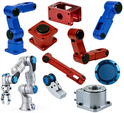
The joint housing, joint bearing seat, elbow support, frame, long shaft parts, etc., are all processed by the five-axis machining center.
Future Trends
AI and digital twin technology will further optimize the tool paths and process parameters of five-axis machining; automated integration (robotic loading and unloading + five-axis machining + automatic inspection) will promote the popularization of "darkroom production". With the release of the demand for mass production of humanoid robots, five-axis machining, as the core supporting technology of precision manufacturing, will have a broader market space.