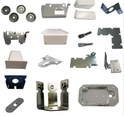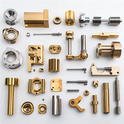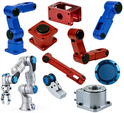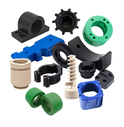

How Precision Manufacturing Empowers the Robot Revolution: The Crucial Role of CNC Part Processing
In the wave of Industry 4.0 and intelligent manufacturing, robot technology is reshaping every aspect from industrial production to daily life at an unprecedented speed. And behind this robot revolution, a key manufacturing technology - CNC part processing - is playing an indispensable role. With its unparalleled precision, consistency and flexibility, it lays a solid foundation for the high performance and reliability of robots.
一. Why is robot manufacturing highly dependent on CNC processing?
Robots are the culmination of precision mechanics, advanced control, and sensing technologies. The ultimate performance of robots heavily relies on the precision and reliability of every single component within them. CNC processing technology precisely meets this demanding requirement:
Extremely high precision and consistency: The movement accuracy of robots often reaches the micrometer level. CNC machines can continuously and stably produce parts with strict tolerances, ensuring that each robot's arm, joints, and connecting rods can perfectly cooperate, eliminating backlash and errors during movement.
Forming ability of complex geometric shapes: Robot components usually have lightweight, hollow, and irregular structures. The five-axis coordinated processing of CNC can complete the cutting of complex three-dimensional contours in one go and from multiple angles, which is difficult to achieve with traditional processing methods.
Widely adaptable materials: From lightweight and high-strength aluminum alloys, titanium alloys, to wear-resistant engineering plastics such as PEEK, and even special composite materials, CNC machining can handle various materials required in the field of robotics to meet the requirements of strength, weight, corrosion resistance, or specific functions.
Outstanding rigidity and surface quality: CNC machining can "carve" parts from solid billets, and its overall structural rigidity is much higher than that of welded or cast components. At the same time, the excellent surface quality reduces friction and wear, prolonging the service life of the robot.
二. Specific Applications of CNC Processing in Key Components of Robots
CNC processing technology has permeated into every core component of the robot:
Joints and reducer housing: This is the "heart" and "joint" of the robot. The internal tooth profile accuracy of the harmonic reducer and RV reducer housings is extremely high. Any imperfection will lead to reduced efficiency, increased noise and shortened lifespan. CNC processing ensures the perfect fit of these critical interfaces.
Robot arm and linkage: These components need to ensure absolute rigidity and strength while also being as lightweight as possible. CNC processing can produce arm structures with complex internal reinforcement ribs and lightweight cavities, achieving the optimization of performance.
End effector: Whether it is a precise gripper, a complex welding gun, or a dedicated visual camera bracket, all require customization based on the task. The small-batch, rapid prototyping capability of CNC machining makes it an ideal choice for manufacturing efficient and durable end tools.
Sensor support and mounting base: Force sensors, vision sensors, etc. need to be precisely positioned. The CNC-machined mounting base can ensure that the sensors are in the optimal position and angle, guaranteeing the accuracy of data collection.
Chassis and Frame: For mobile robots (AGV/AMR) and service robots, the chassis and frame that carry the entire system need to be both sturdy, lightweight, and aesthetically pleasing. CNC-machined aluminum or steel frames are common solutions.
三. Future Trends of Robot Technology Development Enabled by CNC Processing
Future Trends of Robot Technology Development Enabled by CNC Processing
As robot technology progresses, new demands and opportunities have been presented for CNC processing:
More extreme lightweighting: With the widespread adoption of collaborative robots and mobile robots, the demand for lightweighting has become increasingly urgent. CNC machining will be deeply integrated with topology optimization design software to produce ultra-lightweight components in the form of biomimicry and hollow structures.
ntegrated design: To reduce the number of components and enhance reliability, future robot components will tend to integrate multiple functions into a single part. CNC processing can complete the processing of sensor slots, cable conduits, installation interfaces, etc. at one time, achieving a high degree of integration.
Application of new materials: In the face of more demanding application environments (such as high temperatures and strong corrosiveness), CNC processing will be more widely used for processing high-performance alloys, ceramics and composite materials, expanding the application boundaries of robots.
Rapid prototyping and small-batch production: In the fields of robot research and development and customization, CNC machining can quickly transform design drawings into functional prototypes, significantly shortening the product launch cycle.
It can be said that without modern CNC precision part processing technology, there would be no today's high-performance and highly reliable robot systems. It serves as a bridge connecting innovative design and practical application, and is the physical foundation for robots to achieve precise, flexible and efficient movements. As robot technology moves towards more intelligent and refined directions, CNC processing, as its core enabling technology, will also continue to evolve, jointly driving the next wave of industrial revolution.
Key words: CNC parts processing, robot manufacturing, precision processing, robot joints, harmonic reducers, lightweight design, five-axis processing, robot arms, end effectors, intelligent manufacturing.